Introduction
Sleeping in unusual accommodation means choosing to step outside the usual frame.
It means agreeing to slow down, shift perspective and enjoy a stay where the place matters as much as the destination.
In Belgium, this way of travelling is increasingly popular. A few kilometres from home, it is possible to enjoy a different experience, far from conventional hotel standards: a night in a wooden cabin, accommodation nestled in the heart of nature, a space designed to reconnect with what matters most.
This search for the unusual is not born of a mere desire for originality. It reflects a deeper aspiration: to sleep differently, to rediscover a simpler relationship with time, with the environment and with the places we inhabit, even for a short break.
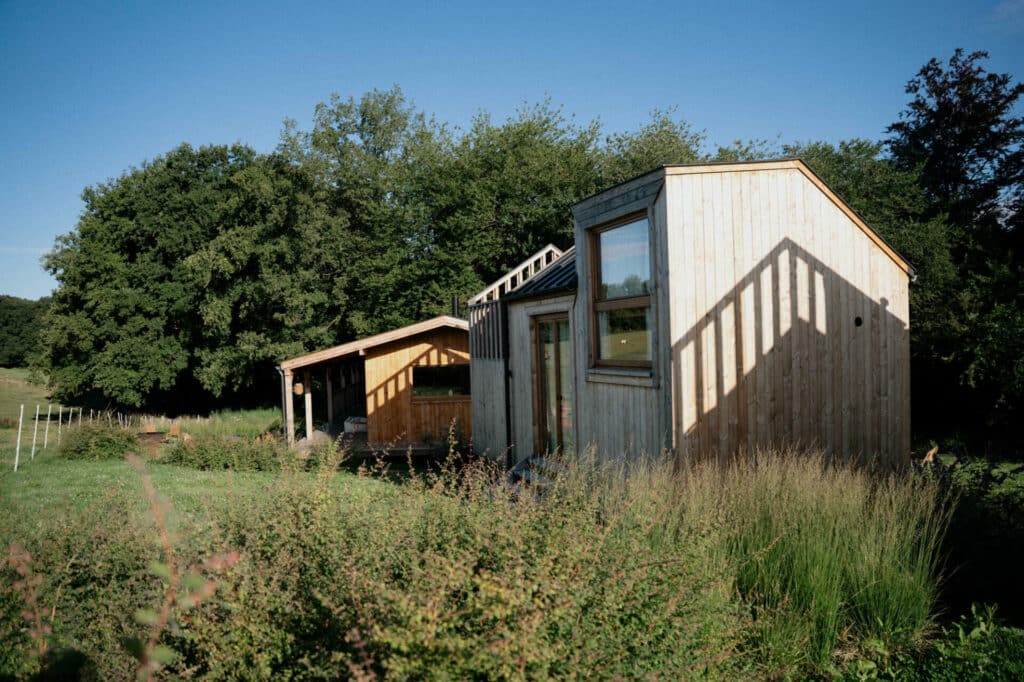
At Le Domaine des Trois Tilleuls, accommodation is more than a roof for the night. It is part of a landscape, a family history, a protected natural environment. The Cosy Cabins are designed as places of immersion, understated and attentive to their surroundings, inviting a slower, more mindful way of staying.
But what does the notion of unusual accommodation really cover?
Is it simply atypical accommodation, or another way of thinking about travel, time and our relationship with place?
Through this page, we aim to define what unusual accommodation is, to understand why this form of accommodation meets very current aspirations, and to explore the different experiences it can offer, from an unusual night to a longer stay, as a couple, with family or with close friends.
This page is intended above all as a foundation for better understanding this world, and for informing the choices of those who wish to enjoy a different experience, closer to nature, silence and what matters most.
1. What is unusual accommodation?
The term unusual accommodation is widely used today.
It appears in the media, on travel platforms and in discussions about sustainable tourism.
Yet there is no single legal or regulatory definition of unusual accommodation.
It is above all an experiential concept, rather than an administrative category.
Academic research also points out that unusual accommodation is defined above all by its ability to break with the ordinary, to surprise and to offer an experience different from conventional tourist accommodation.
1.1 A simple definition of unusual accommodation
An unusual accommodation is tourist accommodation that departs from the usual forms.
It is neither a standard hotel nor a traditional holiday cottage.
According to several specialist players, the unusual rests on three main elements:
- a different shape or architecture,
- a particular setting, often linked to nature,
- a lived experience that goes beyond simply sleeping on site.
The reference site Tendance Insolite defines unusual accommodation as original lodging, set in a privileged environment and designed to offer a complete experience in its own right.
The unusual is therefore not limited to how the accommodation looks.
It is played out above all in how we inhabit the place, even for a short time.
1.2 Unusual accommodation and atypical accommodation: an important nuance
The terms unusual accommodation and atypical accommodation are often used as synonyms.
Yet they do not carry exactly the same intention.
Atypical accommodation describes above all a different form.
It emphasises the originality of the concept or the architecture.
Unusual accommodation, by contrast, places more emphasis on the overall experience.
It introduces a break from everyday life.
It changes our relationship with time, comfort and the environment.
This approach is particularly promoted by nature-oriented platforms such as Natuurhuisje, which value visual singularity less than the relationship between host, place and natural environment.
1.3 Another way of thinking about a stay
Choosing unusual accommodation is not just a change of scenery.
It is adopting another way of travelling.
Comfort is still there.
But it is conceived more simply.
Less showy. More essential.
This vision is in line with the principles of sustainable tourism and slow tourism, as defined by the World Tourism Organization.
According to the UNWTO, sustainable tourism is tourism that takes full account of its economic, social and environmental impacts, while meeting the needs of visitors and host communities.
In this approach, the accommodation becomes:
- an anchor point,
- a place for observation,
- a space to breathe.
It is this way of thinking about a stay that explains the growing interest in unusual accommodation in Belgium, particularly for stays that are close to home and short, yet deeply refreshing.
2. Why choose unusual accommodation in Belgium?
Belgium offers particularly fertile ground for unusual accommodation.
Not out of exoticism.
But through the richness of its landscapes, the proximity of its destinations and a strong culture of meaningful tourism.
Choosing unusual accommodation in Belgium often means choosing local, without giving up the sense of escape.
2.1 Travelling less far, living more intensely
Belgium’s geography makes it quick to change environment.
Forests, countryside and valleys are within easy reach.
This proximity encourages:
- short but frequent stays,
- less time spent travelling,
- better quality of time on site.
This shift in travel habits is well documented by Destination BW, which promotes local tourism experiences and micro-stays in Walloon Brabant.
Unusual accommodation fits squarely into this dynamic.
It turns a nearby stay into a memorable experience, without going far.
2.2 A variety of landscapes suited to the unusual
Belgium stands out for its great variety of natural settings within a small territory.
This diversity encourages accommodation that blends into its environment.
Rather than transforming the landscape, the unusual here is born of immersion.
Of the link between the place, the building and what surrounds it.
This approach is also promoted by Visit Wallonia and Walloon tourism stakeholders, who encourage accommodation that respects the territory and its identity.
2.3 A response to travellers’ new expectations
Travellers no longer look only for somewhere to sleep.
They look for a coherent experience.
Several European studies show growing expectations around:
- calm,
- meaning,
- reconnecting with nature,
- the authenticity of places.
These trends are notably analysed in work on slow tourism, supported by bodies such as the World Tourism Organization.
Unusual accommodation responds to this shift.
It offers less standardisation.
And more connection to place.
2.4 A strong consistency with sustainable tourism
In Belgium, many unusual accommodation projects follow a sustainable approach.
This applies as much to how the accommodation is designed as to how it is run.
This consistency is now recognised through independent labels such as Green Key, which reward tourist accommodation committed to responsible environmental management.
At Le Domaine des Trois Tilleuls, this approach is put into practice.
The estate holds the Green Key label, and reflects a vision of tourism that is attentive:
- to the environment,
- to resources,
- and to the relationship between the place and its guests.
The unusual is then not a marketing concept.
It becomes a coherent way of inhabiting a territory.
2.5 An experience to enjoy all year round
The unusual does not depend on the season alone.
It also depends on the setting and the atmosphere.
In Belgium, unusual accommodation allows for different experiences:
- in winter, in a more introspective atmosphere,
- in spring, with nature in motion,
- in summer or autumn, in step with the landscape.
This ability to change with the seasons strengthens the appeal of the unusual.
3. The main types of unusual accommodation
The term unusual accommodation covers very diverse realities.
It does not refer to a single type of lodging, but to a set of singular forms, designed to offer an experience different from conventional tourist accommodation.
To better understand this world, it is useful to distinguish the main families.
Not to set them against one another.
But to clarify what makes the unusual.
3.1 Cabins and wooden accommodation
Cabins are among the most emblematic forms of unusual accommodation.
They immediately evoke nature, simplicity and a return to essentials.
Built mostly of wood, they favour:
- natural materials,
- discreet integration into the landscape,
- a warm, enveloping atmosphere.
The unusual here does not rest on extravagance.
It comes from simplicity, from the imagery of staying in a wooden cabin and from a direct bond with the material.
3.2 Unusual accommodation in the heart of nature
Another major family groups accommodation designed as places of immersion.
They are characterised by:
- their setting in protected natural surroundings,
- a deliberate distance from urban areas,
- an experience centred on calm and disconnection.
In this accommodation, nature is not a backdrop.
It is an integral part of the stay.
This approach is at the heart of contemporary definitions of unusual accommodation, which emphasise lived experience and relationship to place.
3.3 Other forms of unusual accommodation, outside traditional frames
The world of unusual accommodation is not limited to cabins or natural settings.
It also includes accommodation set up in structures repurposed from their original use or in unexpected contexts.
Examples include:
- yurts, inspired by nomadic living,
- tiny houses,
- accommodation fitted out in former railway carriages, barges or silos,
- accommodation in lighthouses, towers or heritage buildings,
- rooms built into converted industrial or cultural sites.
In these cases, the unusual is born of contrast.
Between the original function of the place and the experience offered today.
3.4 A variety of forms, one intention
Whether they take the form of cabins, nature-based accommodation or reinvented structures, unusual accommodation shares a common intention.
They aim to offer:
- another way of inhabiting a place,
- a break from the usual standards,
- an experience that is more conscious of time and the environment.
The unusual therefore does not depend on a precise typology.
It lies in the attention paid to the lived experience.
It is this diversity, organised around a single aspiration, that makes the world of unusual accommodation so rich.
4. Living the experience: an unusual night or an unusual stay?
Unusual accommodation is not experienced through its form alone.
The length of stay plays a central role in the experience.
An unusual night and an unusual stay meet different expectations.
They involve neither the same relationship to time nor the same involvement in the place.
Understanding this distinction makes it possible to choose more wisely.
4.1 The unusual night: a short experience, but a memorable one
The unusual night is often thought of as a short break, focused on the immediate experience of the place.
It meets several practical motivations:
- enjoying a quick pause without upsetting your schedule,
- marking a special moment (gift, birthday, discovery),
- gaining access to a form of nearby escape.
This logic is found in the offers of specialist platforms, where searches for “unusual overnight stays” bring together cabins, yurts, bubbles, caravans or original lodgings available for a single night. This type of accommodation values the experience itself over a multi-day commitment.
According to the European market for unusual accommodation, the popularity of unusual forms of accommodation responds precisely to this desire for unique experiences that stand out, including for short periods.
In short: an unusual night is a brief experience, but one rich in emotion, and perfectly suited to people who want to try the unusual without committing to a long stay.
4.2 The unusual stay: settling into a slower rhythm
The unusual stay means staying on site for several days.
It follows a logic of longer time.
This length of time allows you:
- to genuinely slow down,
- to settle into a calmer rhythm,
- to build a deeper relationship with the place and its environment.
The accommodation is no longer only a setting.
It becomes the anchor point of the stay.
This approach fully matches the principles of slow tourism, which favours longer stays, proximity and the quality of the lived experience.
At Le Domaine des Trois Tilleuls, this logic is put into practice.
The accommodation is designed to be lived in over several days.
Time is not constrained here.
It stretches at the pace of the place, the surrounding nature and simple everyday routines.
An unusual stay then allows you:
- to make the most of the setting,
- to explore the surroundings on foot or by bike,
- to alternate quiet moments and local discoveries,
- to share time with loved ones, with no imposed programme.
This type of stay meets an expectation that has become increasingly marked in recent years:
that of travelling less quickly, but living more intensely.
An unusual stay is therefore not simply a series of nights.
It is an experience built over time.
A time apart, designed for settling in, observing and breathing.
4.3 Two distinct experiences, one search for meaning
There is no universal ideal length.
The choice depends above all on the purpose of the stay.
An unusual night is often well suited when:
- time is limited,
- the aim is a one-off experience,
- the accommodation is the focus of the stay.
An unusual stay is more relevant when:
- you want to genuinely slow down,
- discover a region,
- share time with loved ones,
- make the experience last.
Identifying this difference beforehand makes it possible:
- to choose accommodation better,
- to adjust expectations,
- and to live the experience more fittingly.
5. Who is unusual accommodation for?
Unusual accommodation is not aimed at a single profile.
It meets different expectations, depending on life stage, length of stay and way of travelling.
What links them, however, is the same search:
to live a more conscious, more embodied experience, closer to the place.
5.1 For two: reconnecting outside the usual frame
Unusual accommodation is often associated with couples’ stays.
It offers a setting conducive to disconnecting and slowing down.
Far from hotel standards, the accommodation becomes an intimate space.
A place to reconnect, without superfluous distraction.
This type of stay is sought for:
- a break for two,
- a weekend,
- a moment to mark.
At Le Domaine des Trois Tilleuls, this experience can take different forms.
Whether in the Cosy Cabins or in the accommodation closer to the castle, the place naturally invites a more attentive presence, in tune with nature and the surrounding silence.
5.2 With family: sharing simple, restorative time
Unusual accommodation appeals more and more to families.
It allows a different kind of stay, without multiplying activities or journeys.
In this setting:
- children discover a different relationship with nature,
- adults slow down,
- the accommodation becomes a living space, not just a stopover.
The Cosy Cabins at Le Domaine des Trois Tilleuls fit this approach fully.
They offer a balance between comfort, independence and immersion in the natural environment.
An unusual stay with family encourages:
- shared moments,
- simplicity,
- renewed attention to time spent together.
5.3 As a group: experiencing the unusual differently, together
Less commonly, unusual accommodation can also be enjoyed as a group.
This dimension is still rare, as it requires specific organisation and a suitable venue.
At Le Domaine des Trois Tilleuls, this possibility is an integral part of the experience.
The estate lets you privatise all the accommodation, offering a coherent unusual setting for a group of up to 18 people.
This set-up opens up particular uses:
- stays among friends,
- family reunions,
- shared moments in a natural, secluded setting.
The unusual is then no longer experienced only individually.
It becomes a collective experience, rooted in a unique place, with no dispersal.
5.4 An experience that adapts to everyone’s intentions
Whether experienced as a couple, with family or as a group, unusual accommodation adapts above all to an intention for the stay.
It does not follow a single logic.
It offers a framework.
A framework in which everyone can:
- slow down,
- reconnect,
- share,
- or simply inhabit time differently.
It is this adaptability, combined with a strong sense of place, that makes unusual accommodation so rich today.
6. What makes a successful unusual accommodation different
Not all unusual accommodation offers the same experience.
The difference lies not only in the shape or originality of the place.
A successful unusual stay rests on a subtle balance.
Between setting, use and hospitality.
6.1 An environment that is part of the experience
The environment is central.
It should be more than mere scenery.
A successful unusual stay is set in a coherent place:
- a legible landscape,
- accessible nature,
- a calm atmosphere.
The relationship with the outdoors matters as much as the interior.
The silence.
The light.
The rhythm of the place.
When the environment is right, it naturally supports the experience.
6.2 Respectful integration into the setting
Unusual does not mean intrusive.
A successful stay respects the site that hosts it.
This means:
- careful siting,
- discreet architecture,
- materials in keeping with the context.
The place is not transformed to host the accommodation.
It is the accommodation that adapts to the place.
This coherence strengthens the sense of authenticity.
6.3 Hospitality in keeping with the experience on offer
Hospitality is at the heart of every tourism experience.
In unusual accommodation, it becomes even more essential.
Sleeping somewhere different often means:
- stepping out of your usual bearings,
- accepting a measure of the unknown,
- experiencing the stay differently.
The welcome then plays a key role.
It should reassure without directing.
Support without imposing.
Successful hospitality in unusual accommodation is characterised by:
- a discreet presence, yet an attentive one,
- clear information, without overload,
- genuine availability, without intrusion.
It should be consistent with the place.
Simple when the accommodation is simple.
Warm without being showy.
At Le Domaine des Trois Tilleuls, this hospitality continues naturally from the setting.
It accompanies the experience without steering it.
It leaves space, while remaining present when needed.
In successful unusual accommodation, hospitality does not try to compensate for the place.
It extends it.
It builds confidence.
And it allows guests to make the experience fully their own.
6.4 Comfort designed with restraint
Unusual accommodation is not synonymous with roughing it.
Comfort is very much present.
But it is conceived differently.
Less showy.
More essential.
The right comfort allows you:
- to feel good,
- without breaking the immersion,
- without overloading the experience.
Every element has its place.
Nothing is superfluous.
6.5 A clear, confident experience
A successful unusual stay knows what it offers.
And what it does not.
It does not try to offer everything.
It stands by a clear intention.
This clarity is essential:
- for visitors’ expectations,
- for the quality of the stay,
- for the overall coherence of the place.
The unusual works when the experience is easy to understand.
6.6 The meaning given to the stay
Finally, what truly sets a successful unusual stay apart is its meaning.
Why the place exists.
What it offers as a way of inhabiting time.
The unusual is not just about sleeping elsewhere.
It invites you to live differently.
When the place, the environment and the intention are aligned, the experience feels self-evident.
Natural.
And lastingly memorable.
7. Unusual accommodation at Le Domaine des Trois Tilleuls
At Le Domaine des Trois Tilleuls, unusual accommodation is part of an overall approach.
It does not rest on an isolated concept, but on a coherent whole: a place, a history, a natural environment and a way of welcoming guests.
The accommodation here is conceived as spaces to live in.
Not simply places to sleep.
7.1 Cosy Cabins in the heart of nature
The Cosy Cabins are one of the clearest expressions of the unusual at the estate.
They sit fully within the natural environment, without transforming it.
Designed in direct connection with the landscape, they favour:
- understated materials,
- a discreet setting,
- a warm, soothing atmosphere.
These Cosy Cabins let you enjoy an unusual stay in the heart of nature, taking the time to slow down and reconnect with what matters.
7.2 The Castle Guesthouse: another form of the unusual
The unusual does not always take the form of a secluded forest cabin.
It can also arise from heritage and history.
At Le Domaine des Trois Tilleuls, the Castle Guesthouse offers a different experience.
Living in a place steeped in history.
Sleeping in an old building that has stood in the landscape for centuries.
This form of the unusual rests on:
- the character of the place,
- family continuity,
- an intimate relationship with the history of the site.
7.3 Experiencing the unusual together: a place designed for groups
One of the estate’s distinctive strengths is its ability to host groups in a coherent, unusual setting.
The site lets you book all the accommodation exclusively, offering a rare experience:
an unusual stay shared as a group, in one unique place, with everyone together.
This arrangement suits, in particular:
- groups of friends,
- extended families,
- shared stays for up to 18 people.
The unusual is then experienced differently.
It becomes a shared experience, rooted in one place.
7.4 Discreet hospitality, in keeping with the place
The unusual accommodation experience at the estate is inseparable from the hospitality that comes with it.
The welcome is conceived as an extension of the place.
Present.
But never intrusive.
Guests have:
- a clear framework,
- useful information,
- real availability when needed.
This discreet hospitality lets everyone make the stay fully their own, at their own pace, with no imposed framework.
It supports the experience without steering it.
7.5 An approach aligned with sustainable tourism
Unusual accommodation at Le Domaine des Trois Tilleuls is also part of a more responsible tourism approach.
The estate holds the Green Key label, recognising practices that pay attention to:
- the environment,
- resource management,
- the impact of tourism on the area.
This coherence strengthens the meaning of the experience.
The unusual is not a gimmick.
It becomes a conscious way of inhabiting a place.
7.6 An experience true to the spirit of the place
Whether it is the Cosy Cabins, the Castle Guesthouse or group stays, unusual accommodation at the estate rests on a single intention.
To offer:
- a clear setting,
- a sincere experience,
- time set apart, without excess.
The unusual is never forced here.
It asserts itself naturally, through the place, the rhythm and the way guests are welcomed
8. Frequently asked questions about unusual accommodation
Unusual accommodation is lodging that departs from traditional forms of tourist accommodation.
It stands out through an unusual experience, an original setting, or immersion in nature or in a particular place.
It covers cabins, bubbles, tiny houses, yurts, houseboats and other forms of nature-based or atypical accommodation that are not conventional hotels.
The cost of unusual accommodation varies with the type of lodging, the season and the length of stay.
In Belgium, a night in unusual accommodation can cost roughly €100 to €300 or more, depending on comfort, equipment and the services included.
Yes.
Many unusual accommodations in Belgium are designed for use in every season.
Some structures (such as bubbles, tiny houses or isolated cabins) have suitable heating or insulation systems.
– An unusual night focuses on a short experience: a single night or a weekend dedicated to escape.
– An unusual stay generally involves several nights, allowing you to experience the discovery of the place and its surroundings more deeply.
This distinction lets travellers choose according to their expectations: emotional intensity or extended immersion.
There are many forms of unusual accommodation, including:
– cabins in the middle of nature,
– tiny houses or micro-homes,
– transparent bubbles,
– yurts,
– houseboats,
– accommodation built into heritage or historic structures.
Each type offers a different experience, depending on the place, the comfort and the purpose of the stay.
Yes.
Even though the word unusual suggests the unexpected, many places offer complete comfort (comfortable beds, heating, bathrooms, sometimes a hot tub or jacuzzi, and so on).
This comfort is designed without breaking the immersion in the experience.
Yes!
Many unusual places suit groups, particularly when several units are available on the same site.
At Le Domaine des Trois Tilleuls, it is even possible to book all the accommodation exclusively for groups of up to 18 people, which is rare among unusual accommodation.
It depends on each place.
Some offer breakfast, brunch or meal options, either included or added at booking, while others leave the choice open.
It is always advisable to check the details when booking.
The arrangements vary from one place to another.
In general:
– Arrival (check-in) in the late afternoon or early evening.
– Departure (check-out) in the morning.
The exact times are confirmed at the time of booking.
Cancellation and amendment conditions vary according to each place’s policy.
Some allow free cancellation up to several weeks beforehand, while others charge fees depending on the time remaining.
It is essential to check the specific cancellation policy when booking.
Conclusion: sleeping differently, quite simply
Unusual accommodation is not just a form of lodging.
It offers another way of inhabiting time, place and the stay itself.
Whether for one night or several days, as a couple, a family or a group, the essentials remain the same:
finding the right setting, one that is clear and sincere, in tune with your expectations.
At Le Domaine des Trois Tilleuls, this approach is expressed through accommodation designed to help you slow down, reconnect and enjoy an experience rooted in nature and place.
For those who want to go further, discover the accommodation or plan their stay, it is possible to explore the estate’s different offerings, at whatever pace suits them.